
Understanding AI to Best Serve Youth
In an era of rapid technological change, youth-serving professionals recently gathered in Boston at The Possible Zone (TPZ) to answer a critical question: How do we navigate the Artificial Intelligence (AI) revolution? Over the course of a packed three-hour workshop – on a Friday afternoon before a long, holiday weekend – 46 dedicated and enthusiastic team leaders and direct service providers joined The Possible Zone (TPZ), the City of Boston, Office of Youth Engagement and Advancement (OYEA) and the American Civil Liberties Union of Massachusetts (ACLU of MA), to kick off the fall OYEA Partner Network Professional Development Series.
 The workshop, Navigating AI: Tools, Ethics, and Impact in Youth Work was the result of an OYEA Partner Network Meeting that TPZ team members attended, during which the OYEA team asked participants, “What do you want to learn more about?” Many topics were requested, and AI was at the forefront.
Why would a room full of youth-serving professionals want to learn about AI? Why is it essential for youth-serving organizations to invest time in understanding AI and how it impacts our youth? The answer is in the title of the workshop: Tools, Ethics, and Impact. Let’s dig into each and share tips on how to navigate AI.
Tools:
At TPZ, preparing students for careers that foster economic mobility means staying ahead of industry shifts. According to McKinsey’s The State of AI in 2026, 44% of organizations are already scaling AI across their enterprise, up from 38% last year. As AI transforms high-demand fields, fluency in navigating AI tools is essential to closing the opportunity gap for our students.
A Navigating AI workshop participant reflected during the session on this shift: “Very similar to the internet, people made a lot of assumptions… because we were in the stage of uncertainty. That’s where we are with AI now; AI is moving faster than expected, and the time to prepare our future leaders is now.”
Our students are already using AI. About 57% of teens in the U.S. use AI for information, help with school work, fun and entertainment, and emotional support. Youth-serving professionals are committed to removing barriers for students to help lead to their success. Learning to navigate AI can be another strategy to help students develop skills and use AI in a productive way.
Ethics:
AI is everywhere and growing rapidly. A very insightful question related to ethics and accountability came up in the workshop. One participant asked, “What does accountability look like, because you know we can’t put AI in jail, so who do we hold accountable?”
The ACLU of MA joined the Navigating AI workshop as experts on the intersection of technology and civil liberties. This intersection may not be something people think about daily; however, the ACLU of MA team works hard to make sure privacy protections are preserved according to our U.S. and State constitutions.
Is AI right or wrong? The question should perhaps be more about, “What is the right way to use AI as a tool in education?” As adults who work with young people closely, we can help our students make ethical decisions when using AI tools to help them refine the visions they have in their minds.
“A question for young people is how do you want to learn? What tools do you want to incorporate? We should have this conversation together,” a workshop participant powerfully reflected. This series of questions really highlighted the role organizations can play in making sure AI remains a productive tool for youth and allows them to produce work they can be proud of.
Impact:
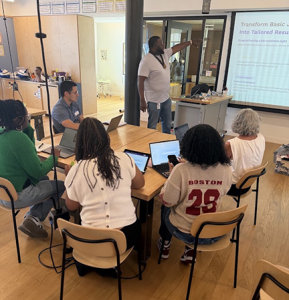 “Our current education system was made for the Industrial Revolution, not the current AI technology revolution that’s present,” one participant shared about the current impact of AI.
Undeniably, AI is having an impact all over the world. “AI will take on work in law, customer service, medicine, software, and manufacturing. It will hit these industries rapidly, over the course of a decade rather than a few generations,” shared another attendee. Although the final impact is unknown, we know that our students are being impacted by AI already in many ways. If we ignore the biggest elephant in the room, it does not make it disappear. If we ignore the demand of AI, the demand does not disappear.
Navigating AI:
After exploring “Why?”, let’s jump into the “How?” No matter what your position is in an organization, it is possible to have a role in navigating AI. Here are some simple suggestions that can help:
- Present the facts: Use data to tell your story. Share with leadership how AI is coming up in your work and how you are managing those conversations.
- Explore tools: Begin to go on your own AI journey. Ask yourself: Can AI help refine external communications? Can it help make your schedule easier to manage? Can it help deepen research for your students? How much time will it take to explore and learn these new tools?
- Work with your team: Is this right for your organization? Work with your team to develop a shared understanding and policy for AI within your organization. How is it being used and does that align with your organization’s plan for team members and youth?
- Stay curious: AI is growing rapidly and so are the resources available to learn more about it. Research, try affordable tools, ask bold questions, encourage others to share what they know about AI with you and support the youth you work with to be responsible, curious, and strategic!
The energy in the workshop rooms was a powerful reminder: navigating the AI revolution is not a task we should tackle in isolation. The change is happening, but we can ensure it is a shift that empowers the next generation.
– Adanma Ude is Senior Director of Program Partnerships (Brockton) at The Possible Zone.