Spotlight: Carebots Deep Dive
 What does it mean to design technology that actually cares for the person using it?
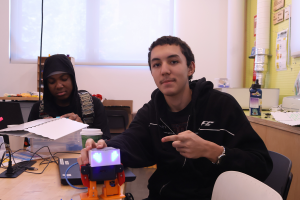
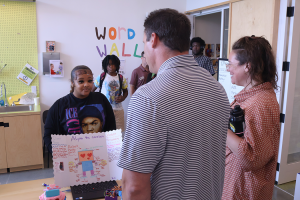
That question was at the heart of a recent How to Build a Carebot Deep Dive at The Possible Zone (TPZ), during which students explored the intersection of robotics, AI, healthcare, and human-centered design by creating social robot companions for people with specific needs.
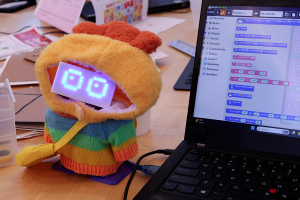
To bring their Carebots to life, students wired motors and sensors, programmed Arduino hardware, wrote block-based code, and applied the user-centered design process to make decisions around their robots’ behaviors, features, and personalities. But building the technology was only part of the challenge. Students were also encouraged to ask questions about the technologies they were using: How does AI work? What happens when data is biased? How should a robot behave when it is designed to support a person? And what makes an interaction with technology feel helpful, human, or even unsettling?
Students explored data bias and prosocial AI principles with The Rithm Project, practiced prompt engineering, and trained their own machine learning models using Teachable Machine.
 A visit to the Personal Robotics Group at MIT Media Lab gave students the opportunity to investigate those questions alongside emerging social robotics technologies. Students uploaded their machine learning models to Doodlebot, an educational prototype for which behavior, movement, learning, and drawing can be programmed and modified. They also wrote prompts for and interacted with Jibo, a social robot designed for the home that uses movement, expression, sound, and responsiveness to communicate.
Rather than simply experiencing these technologies, students critiqued them. They noticed what felt engaging, what felt uncomfortable, and how design choices shaped their reactions to a robot – then brought those observations back to their own work.
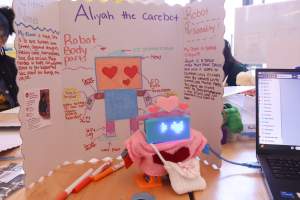
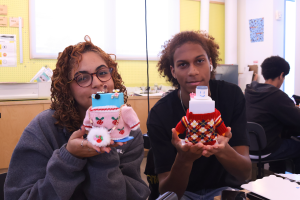
For their final projects, students designed Carebots to delight and accompany specific users, thinking especially about how technology might support people’s care and well-being. Each robot had custom-coded behaviors and a distinct personality: changing facial expressions, sharing messages, dancing, singing, and responding to interaction. Students considered how movement, light, sound, and texture could communicate care – and how something as subtle as a gesture could be created through code.
The result was a collection of wonderfully different little companions, complete with tiny outfits and endearing personalities.
But the Carebots were also a vehicle for something bigger: helping young people see themselves not just as users of new technologies, but as people capable of questioning, critiquing, designing, and shaping them. As AI and robotics become increasingly present in healthcare and our everyday lives, students need opportunities to ask not only “How does this technology work?” but also “Who is it designed for, how does it affect them, and how could we make it better?”
Thank you to TPZ Program staff Sabrina Tirachen, Tori Saia, and Shani Mensing for leading and supporting this program, as well as Sarah Gillet and our other incredible partners at MIT Media Lab for helping make this Deep Dive into social robotics possible!
–Aiden Stein, Communications Intern, The Possible Zone