
Designing Futures: Robotics and Pathways to Careers of the Future
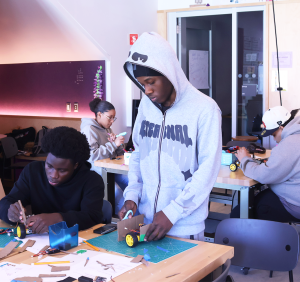 Walking into a robotics class at The Possible Zone, visitors notice something subtle but powerful. Students aren’t just assembling parts or writing code. They’re identifying opportunities, making decisions, testing ideas, navigating challenges, and collaborating in teams. In other words, they’re practicing the very conditions of modern work. The teaching and learning of robotics isn’t only about building the robot. It’s about building the durable skills and entrepreneurial spirit for young people to shape their futures.
Often, robotics is seen as a technical pathway, a pipeline into engineering or computer science. That framing is too narrow for the digital age we’re experiencing. The fastest-growing fields today – healthcare, advanced manufacturing, climate tech, and AI-enabled services – require not just technical knowledge, but the ability to adapt, communicate, and solve complex problems across disciplines. Robotics, when designed intentionally, sits at that intersection.
Research helps explain why this matters. Studies on STEAM identity show that when students see themselves as capable contributors in technical fields, they are more likely to persist in those pathways. At the same time, research on work-based and career-connected learning highlights the importance of real-world application and exposure to industry in expanding both opportunity and access to in-demand careers. Yet, skills alone aren’t enough. Young people need experiences that connect learning to purpose and to possibility.
At The Possible Zone, robotics is designed with that in mind. In Battle Bots, a week-long immersive project-based learning experience in which students create remote-controlled vehicles, they don’t start with a set of step-by-step instructions. They begin with an authentic challenge: design a machine that can compete, adapt, and perform. What follows is a cycle of prototyping, testing, failing, iteration, and refinement. Early designs are made of paper or cardboard; later versions incorporate precision tools like laser cutters or 3D printers. As students make decisions about structure, coding, and clarity of their instructions, they also articulate their thinking to explain how their systems work and respond to feedback.
As TPZ educator Evan Denenberg notes, “Students learn communication while they teach their classmates and other stakeholders about their bots.” In this way, communication is not separate from the technical work; it’s embedded within it, strengthening students’ ability to translate complex ideas, collaborate effectively, and make their thinking visible in ways that matter for future pathways.
What’s happening during this process is important, and we benefit from unpacking the steps educators take, almost by sleight of hand: as students struggle to build, ideate, receive feedback, and try again, they are developing durable skills that employers across sectors are seeking. Programming a robot to navigate a space or complete a task requires more than technical execution; it requires anticipating variability, designing for uncertainty, and thinking in systems. These are the same challenges faced in industries ranging from hospital automation to supply chain logistics to environmental monitoring.
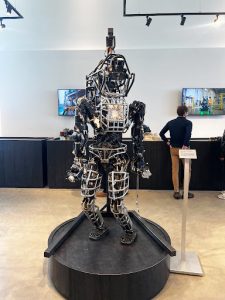 The connection to careers also becomes clearer when learning extends beyond the classroom. When students work side-by-side with industry professionals or go on site visits to see how technologies are used in the field, the work takes on new meaning. Last February, TPZ Pathways students visited Boston Dynamics, where they toured the facility, spoke with software engineers and mechanics, and observed a demonstration of the Atlas robot. Research suggests that these kinds of experiences build social capital and expand students’ access to networks and opportunities that shape long-term outcomes.
Just as importantly, students answer critical questions they may not have even considered previously: What’s possible? Where could this take me? This is where robotics becomes more than a technical course. It becomes a bridge to agency. A bridge between school and industry. Between skill-building and identity. Between what students are learning and who they are becoming.
As I’ve written previously, meaningful learning experiences are not one-off activities but sustained processes that engage identity, relationships, and real-world application. Robotics, when embedded in that kind of design, creates opportunity. Students address real-world challenges that increase in sophistication. They build technical knowledge as well as confidence and a sense of belonging and contributing to a professional community.
At TPZ, we believe robotics should do more than teach technical skills. It should expand how young people see themselves and expand what they believe is possible. It should help students see the relevance of their work across fields and begin to imagine themselves in those spaces.The goal isn’t to design robots, but to prepare students to navigate – and shape – a world that is increasingly complex, technological, and deeply human.
Robotics is a powerful place to start.
Meg Riordan, Ph.D., is Chief Learning Officer at The Possible Zone.