
Who You Know Matters
Who you know matters. A lot. In fact, social capital is one of the most critical and unevenly distributed assets for young people. Research from Harvard Opportunity Insights shows that “economic connectedness” – relationships with people from different socioeconomic backgrounds – is one of the strongest predictors of upward mobility. Yet many high school students, particularly those from historically marginalized communities, have limited access to the kinds of networks that open doors to internships, careers, and postsecondary pathways.
This gap is not only about exposure; it is about being positioned to create and sustain relationships that carry opportunity. As the Brookings Institution noted, networks influence everything from job placement to career advancement. And increasingly, employers are signaling that durable skills, experience, and connections matter alongside, or even more than, traditional credentials. The result is a reinforcing cycle: those with access to networks gain more opportunity, while those without remain excluded.
In today’s digital age, the paradox is striking. Young people are more connected than ever through social media, online communities, and digital platforms, yet they often lack access to meaningful, opportunity-linked relationships. Digital tools can expand visibility, but they rarely replicate the trust and mentorship that come from sustained, real-world interactions. Research from Search Institute underscores that developmental relationships – those that express care, challenge growth, provide support, share power, and expand possibilities – are foundational to young people’s learning and identity formation. Without these, connection remains shallow, and opportunity remains distant.
At The Possible Zone (TPZ), we see social capital not as a “nice to have” byproduct of learning, but as a “need to have” core design principle. This means creating experiences where relationships are not incidental: they are intentional and sustained over time.
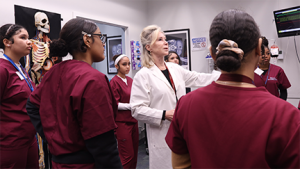 Students don’t just complete projects; they engage alongside industry professionals who serve as collaborators, mentors, and connectors. In a LaunchLab focused on healthcare, TPZ collaborates with Harvard Medical School (HMS) MEDScience to inspire hands-on STEM experiences to deepen technical knowledge and durable skills like problem solving, critical thinking, adaptability, and self-efficacy. Students engage in intensive clinical training, using professional-grade simulators and high-fidelity manikins to mirror real-world medical environments. Working in collaborative cohorts with medical professionals, students showcase their learning through authentic practice. Whether portraying a patient to demonstrate diagnostic symptoms or functioning as a medical team to assess vitals and execute emergency procedures, students work with tools, processes, and people that position them for future in-demand career pathways.
What matters is not only the moments of interaction, but the progression: from exposure, to relationship, to contribution. Over time, students begin to see themselves not only as learners, but as participants in professional communities. This mirrors what other models like Big Picture Learning and CAPS have demonstrated: when students have sustained engagement with industry partners, they develop both the technical skills and the networks that translate into real opportunities.
At TPZ, this work is further strengthened through reflection and documentation. Students capture their experiences through artifacts, presentations, and reflections and build a body of evidence that makes their skills visible. This not only deepens learning, but also creates a bridge to future opportunities. When a student can articulate how they solved a problem, collaborated with a team, or adapted to a challenge, and connect that to real-world contexts, they are no longer just describing what they did. They are demonstrating who they are becoming.
If we are serious about expanding economic mobility, we must design learning environments that intentionally build social capital, connecting young people to people, experiences, and pathways that widen their sense of what is possible. Because for young people, access to opportunity isn’t just about preparation. It’s about connection.
Meg Riordan, Ph.D., is Chief Learning Officer at The Possible Zone.