Beyond the Transcript: Why the Future Demands a New Learner Record

It’s graduation season. Through mid-June, seniors walk across stages and receive their diplomas—the certification that they have successfully completed all their high school academic requirements. The proof—and the passport to their future—is the high school transcript.
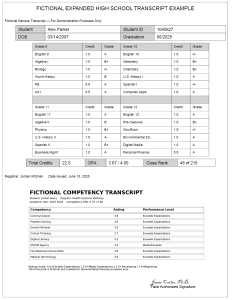
But transcripts, as we’ve known them, compress complex learning and development into blunt signals. A single letter grade per course flattens everything—content knowledge, compliance, collaboration, applied problem-solving—into one undifferentiated mark. Even when teachers design rich, multidimensional assessments (and many do), the transcript doesn’t preserve that complexity. What arrives at a college admissions office or an employer’s desk is a GPA—a number that says little about how a student thinks, what they can build, or who they are becoming. And for students from communities historically underserved by traditional schooling, that information loss isn’t neutral—it reinforces cycles of inequity by making durable skills and emerging identity invisible to the people and systems that control access to opportunity.
However, the landscape is shifting. Universities are expanding test-optional admissions and experimenting with new, holistic ways to identify potential. Employers are signaling that what matters most isn’t just technical knowledge, but adaptability, communication, and the ability to learn continuously. And students themselves are responding, driven by skill-building through informal learning and opportunities to pursue in-demand careers in an increasingly complex and shifting digital age. At Brockton High School, where Principal and TPZ Board Member Kevin McCaskill is seeing historic demand for Career and Technical Education, nearly half of the freshman class—447 applicants—sought entry into just 300 CTE spots this year, across programs ranging from clean energy to biotechnical engineering.
Young people understand that the future requires applied, hands-on mastery. The challenge is that our systems for recording that mastery haven’t caught up.
 Making Growth Visible
At The Possible Zone, we aren’t waiting. Our Theory of Change describes a progression from “I could” to “I can” to “I am,” a shift in which students move from exposure and curiosity toward confidence, and ultimately toward occupational identity: a sense of who they are becoming in relation to meaningful work, what they enjoy, what they believe they’re skilled at, and where they feel they belong.
Traditional transcripts don’t capture that progression. So at The Possible Zone, we’re building something that does—a dynamic learner record grounded in three dimensions:
- What students do. In our LaunchLabs and CTE pathways, students produce tangible evidence of applied learning—coding a Micro:Bit, prototyping a robot, earning an industry certification. These artifacts demonstrate mastery in context, not compliance in isolation.
- What students say. Through our TPZ Navigator mobile app, students document their work, reflect on their process, and connect artifacts to specific competencies. The app acts as a co-pilot, helping students articulate what they’re learning and how it connects to who they’re becoming. Over time, students build a narrative of growth that belongs to them.
- What educators see. TPZ educators document student learning in real time, noting specific behaviors that signal competency growth. This isn’t a grade; it’s a recognition—an affirmation from a trusted adult that a student’s growth is real, visible, and valued. That validation matters. As TPZ educator Sabrina Tirachen recently reflected, “I love being able to log whenever I see a student say/do something wonderful. Now, I have a place to track my anecdotal evidence that shows competency growth.”
When you combine what a student does, what they say, and what educators see, you move beyond a flat transcript toward a multi-dimensional record of learning—one that makes competencies, growth, and identity visible to the people and institutions that open doors.
From Record to Opportunity
Our long-term vision is that this learner record doesn’t just sit in a portfolio. It connects directly to opportunity—pairing demonstrated skills with internships, dual-enrollment pathways, and Careers of the Future. We call this an Opportunity Matcher: a system in which what students have built and who they are becoming opens specific, relevant doors. A student whose record demonstrates collaboration, technical prototyping, and a growing interest in healthcare could be matched to a clinical internship at Lawrence General Hospital—not because they checked a box, but because their learning made them and their competencies and experiences visible.
This is what moving from a time-based model to a mastery-based, personalized model looks like in practice: a redesign of what we track, how we validate it, and who benefits.
As the class of 2026 walks across the stage this season, the question isn’t just what they’ve completed. It’s whether our systems are designed to make visible what they’ve become—and to connect that growth to what comes next.
That’s the learner record we’re building.
– Tim Nystrand is Senior Director of Learning Systems at The Possible Zone