
Career Connected Learning: A new social contract – SXSWEDU27 Proposal
Play this video to learn more about the SXSW EDU proposed panel, “Career-Connected Learning: A new social contract.”
[VOTE FOR THIS PANEL]
SXSW EDU 2027 Proposal
Session Title: Career Connected Learning: A new social contract
Session Format: Panel Discussion (60 minutes)
Primary Track: Future of Work / Career-Connected Learning / K-12 Innovation
 Description:
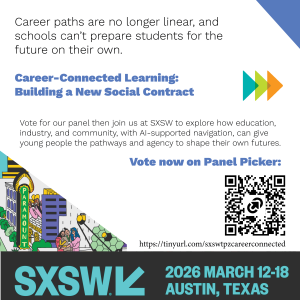
Career paths aren’t linear anymore, and schools can’t prepare students for the future alone. AI is reshaping work, and employers now prize adaptability over credentials, and social capital – networks, mentors, real work experience – matter as much as academic prep. Yet too many young people graduate without either. This panel digs into the guidance gap: how career-connected learning becomes a new social contract across education, industry, and community, and how mentorship, industry projects, and AI-supported navigation can give young people the pathways and agency to shape their own future.
Key Takeaways:
Participants will:
- Explore how different stakeholders can share responsibility for preparing young people for careers of the future and helping them to thrive.
- Learn how AI, competency-based learning, and trusted adults can help students navigate pathways while keeping options open.
- Discover how career-connected ecosystems can intentionally build skills, social capital, and economic mobility.
Moderator:
Meg Riordan
Meg Riordan, Ph.D., is an education leader with 25+ years designing learning ecosystems that expand access to careers and economic mobility. At the Possible Zone, she leads thought leadership, focused on preparing young people for in-demand careers. Formerly Director of External Research at EL Education, she led a national study on curriculum, coaching, and impact on teachers’ practices and students’ achievement. A former NYC Outward Bound Schools Regional Director, she oversaw a network of schools and led scaling efforts. Meg co-authored Going to Scale with New School Designs and has published in peer-reviewed journals (e.g., Journal of Experiential Education) and publications (e.g., Ed Week, Edutopia). Her work bridges education and industry to reimagine opportunity.
Speakers:
Alex Bulis
Alex Bulis is Chief Product & Technology Officer at Britebound, where he leads the vision, strategy, and development of innovative digital career readiness solutions that help young people explore careers, build skills, and navigate their future. Prior to Britebound, Alex held leadership roles at BigID, Riverbed Technology, Aternity, and Comverse, leading product, education, and technical enablement initiatives. He holds an MBA from Boston University’s Questrom School of Business and a B.S. in Electrical Engineering from the Technion.
Amanda Holloway
Amanda Holloway, Ed.D., is a Research Manager at the Project on Workforce at Harvard, a cross-school initiative between the Harvard Kennedy School, the Harvard Business School, and the Harvard Graduates School of Education. Her current work spans across three research areas: career navigation, community colleges, and investigating the intersection between career readiness and civic readiness. She leads research from study design to data collection, analysis, and writing, translating evidence to actionable insights for policy and practitioners. Her commitment to education has been a constant theme throughout her career– she taught elementary and middle school math in Nashville for five years, and worked on the partnerships team at DC Public Schools through the Education Pioneers Fellowship.
Pam Eddinger
Pam Eddinger is president of Bunker Hill Community College (BHCC), the largest of 15 community colleges in Massachusetts, serving 16,000 students. Dr. Eddinger began her tenure at BHCC in 2013 and previously served as president of Moorpark College in Southern California from 2008.
Dr. Eddinger’s service in the Community College movement spans 30 years, with senior posts in academics and student affairs, communications and policy, and executive leadership. Dr. Eddinger’s board and commission service has included: WGBH Boston, the Greater Boston Chamber of Commerce, the Boston Foundation, the Massachusetts Workforce Development Board, the Boston Private Industry Council, the Institute for College Access and Success (TICAS), the American Association of Colleges and Universities (AAC&U), the American Council on Education (ACE), Achieving the Dream (ATD), and The New England Commission of Higher Education (NECHE). Dr. Eddinger was honored by the Obama White House as a Champion of Change. More recently, she was appointed by US Secretary of Labor Martin Walsh to serve as the Chair of the Advisory Committee on Apprenticeship. She earned a bachelor’s degree in English from Barnard College and her master’s and doctorate in Japanese Literature from Columbia University.
VOTE FOR THIS PANEL
Do you have a question you want the panelists to address? Please share it in the Comment section below.