
Building Adaptability: Adjusting Mindsets and Actions
The summer after my freshman year in college, my parents drove me to the Greyhound Bus Station in Chicago, and I rode up through Minneapolis to Duluth, Minnesota, to participate in an Outward Bound course along the border of Canada.
I set off into the wilderness with a group of five other students and two instructors. We had canoes and oars, tall backpacks stuffed with clothes and our camping gear, plus assorted f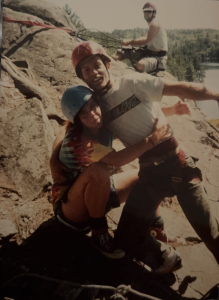 ood and climbing equipment. During the course, I learned to paddle and portage the canoe, navigate waterways using a map and the stars, put up a tent and make a fire, and safely belay my rock climbing partner. But I learned more than the technical skills of outdoor adventure. I learned to communicate effectively with my group, make collaborative decisions to identify the best route to the next island, share camp cooking and clean up responsibilities, and hold each other accountable to leave no trace of our presence as we departed our campsites.
Most importantly, I learned to adapt to the conditions of our environment and the conditions of our group dynamics. Did someone need encouragement to hoist the canoe over their head or navigate a rocky trail? Did the weather require us to seek shelter or continue paddling? What my Outward Bound experience did was place us in unpredictable circumstances that required constant problem-solving, real-time decision-making, ongoing communication, and emotional resilience.
Years later, when I was in grad school and writing my dissertation, I understood that Outward Bound’s intentional model is designed to place a learner into unfamiliar situations and spark adaptive dissonance that leads to problem-solving, learning, collaboration, and applying durable and technical skills to address challenges. Those conditions, within a supportive environment, created the opportunity for meaningful learning. Afterwards, based on the model, learners reflect on their experience and transfer their learning to their lives.
Why share this story of Outward Bound in a blog post about The Possible Zone (TPZ)? Here’s why: in education and workforce development, we increasingly talk about how young people need adaptability in their future career pathways. Yet our systems for schooling continue to reward the opposite, with assessments often asking young people to reproduce predetermined steps toward a known answer.
Adaptability, a TPZ competency defined as “Being able to adjust emotions, thoughts, and behaviors to new situations or changes when the outcome is not clear,” develops when young people encounter uncertainty, make consequential choices, receive feedback, and revise their approach. Research indicates that adaptability plays a key role in our engagement and growth. If we want students to thrive in a changing economy, we need to design more learning experiences where they don’t already know exactly what happens next.
At TPZ, we design immersive Deep Dives that center around building STEAM and durable skills and gaining exposure to career pathways. Like Outward Bound, young people encounter unfamiliar tools, ideas, people, and need to adapt as learners in order to design products, interact with industry partners, solve-problems, and navigate uncertainties. In this way TPZ cultivates adaptability by providing students with opportunities that spark curiosity, lead to inquiry and innovation, and help them develop skills they can apply to their lives and careers.
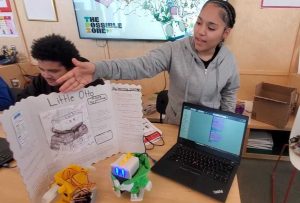 Recently, in How to Build a Care Bot Deep Dive, students had a “challenge by choice,” moment to select independent work or rely on a written guide to support them in creating their robot. One student, who opted to work on his own, hit a wall while trying to position his robot’s motors and legs and connect them to the shield and board that serve as the “brain” and pathways for the robot’s movements. Educator Sabrina Tirachen explained, “Building the robot required a kind of puzzle-solving process. The guide is almost like the grid from the Battleship game, and helps students to determine exactly where each component belongs. This student was physically stuck in the building – he grappled with where to place the components – plus he was also mindset stuck: he believed figuring it out independently meant figuring it out alone.”
She observed that as he continued with the same approach, he struggled to make progress. “To move forward, he had to adapt,” Sabrina explained. With some encouragement, he accessed the build guide, sought out an educator, and began connecting with peers who were wrestling with similar challenges. His breakthrough wasn’t just getting the components into the right position, it was changing his understanding of what it means to be an independent, and interdependent, learner. By the culmination of his build, independence looked less like “I can do this all by myself,” and more like, “I know what to do when I don’t know what to do.”
This is the kind of adaptability we design for at TPZ: we create opportunities for young people to try, offer space to recognize when an approach isn’t working, invite them to draw on new resources and perspectives, and adjust actions and mindset to move forward.
The future won’t always come with a build guide. Young people will encounter evolving technologies, shifting labor markets, and pathways that don’t unfold as planned. Adaptability isn’t a “nice to have,” but is fundamental to how they learn, work, and shape their lives.
Our role is to create the conditions for students to practice and grow their adaptability. That means designing learning environments that deliberately include uncertainty, choice points, and productive struggle. We need to provide opportunities to encounter obstacles, seek help from others, revise thinking, and try new approaches, while also establishing the relationships that support risk-taking.
My Outward Bound instructors could have told me where to paddle and how to solve every problem our group encountered, but they didn’t. The uncertainty was part of the design, and it’s this opportunity we have in front of us as schools, programs, and designers of learning experiences. Instead of creating learning that follows a specific route with one right answer, we need to design systems and experiences that help young people develop the adaptability to navigate when there is no map so that they can shape their futures.
–Meg Riordan is Chief Learning Officer at The Possible Zone.