Designing Engaging Career-Connected Educational Programming
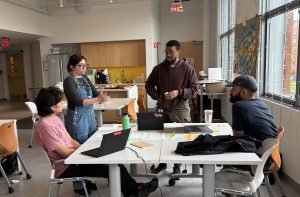 In our work at The Possible Zone, we aim to equip high school students with the agency and skills to face an ever-changing professional world. We often sit at the intersection of seeking to design engaging learning experiences and providing industry exposure that builds durable skills (like communication, problem solving, and adaptability). Balancing these priorities can sometimes be difficult to achieve with quality and authenticity.
For example, consider the creativity, partnership engagement, and balance of technical and durable skills it takes to embed healthcare diagnostic practices into a ten-week project-based learning experience! While there is no single blueprint for connecting young people to career paths, I wanted to share how we navigate that challenge at TPZ. How we design these experiences gets to the heart of what learning can look like when it’s grounded in real-world careers, strong relationships, and active student engagement. Here’s a look at our process:
After completing an academic year, our Program Team comes together to generate new classes that we’ll develop over the course of the next year. This event is called the TPZ Program Hackathon, a design sprint where over a three-day period, we gather insights from both industry partners and students, ideate ideas for novel intersections of student interest and industry, and prototype and test those ideas with our youth. As one of the lead designers of the Hackathon, I’ll unpack our three-day process to show how we design with intention, ensuring both industry professionals and our students hold a real stake in shaping what we teach.
Day 1:
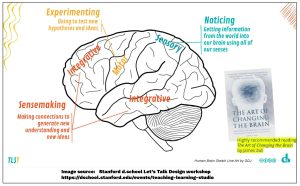 The first day is an opportunity for participants to “Notice” – a concept defined by the Stanford d.school as “getting information from the world into our brain using all of our senses.” In the Hackathon, we do this by researching sectors for personal connections and interviewing industry experts across our Careers of the Future (CoF) fields: Healthcare and Construction, Infrastructure, and Energy (CIE). Crucially, we also interview our students to understand how they view their transition out of high school and how they are actively preparing for that next step.
After the period of Noticing we engage in “Sense-Making”- Making connections to generate new understandings and ideas. This looks like documenting all of our Noticings, posting them around the room and having participants create clusters that combine items that are proximate to one another in some way. For instance, a students’ interest in fashion can connect to the need for wearable technology in health diagnostics. These clusters provide us with a basis to ideate, which we do by bridging student interest, industry insights, our STEAM makerspace tools, and technology. After narrowing down our class ideas to ten we create groups to begin further formulating these ideas.
[Image from Stanford d.school’s Let’s Talk Design workshop.]
Day 2:
Our groups create an overview of their course according to a rubric. Participants then meet with different departments across the organization to ensure the feasibility of the course. We meet with our finance team to ensure the class is fundable; we dialogue with Development to identify what language funders are most responsive to; we also meet with industry experts to receive advice on how to further enrich the course with field-specific skills and 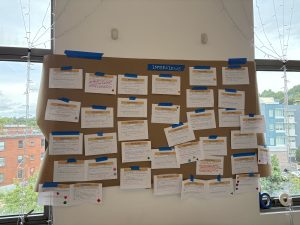 language. Once a team has gotten the green light, they are free to begin prototyping. Testing feasibility early keeps our design process grounded and intentional. It guarantees that the time we spend building curriculum results in something truly viable for our students and aligned with our vision.
Day 3:
On the final day, participants translate their course pitches into short, interactive activities that give students and families a real taste of the curriculum. For example, one team pitched an urban planning class where students analyzed their local environments, identified systemic inequalities, and engineered communal solutions. Equipped with a budget, a hand-drawn map, and cardboard artifacts—like benches, trees, bathrooms, and a skate park—students were tasked with redesigning a neighborhood park. These prototype sessions give students a chance to test their interest in the subject and see how the course connects to real-world career paths. Once prototyping wraps up, teams facilitate these mini-experiences for the students. After which parents, partners, and families vote on which experiences they think captured student interest best and also reflects the specified career sector best. The winning courses are what we bring to life in the coming year.
This year’s winners included:
- Construction, Infrastructure, and Energy:
- Resilient Tiny Homes – A class where students develop models of tiny homes that are meant to withstand extreme weather events that are developing due to climate change.
- Healthcare
- CSI – A class where students use the framework of a CSI investigation to learn the basics about the roles and responsibilities of medical laboratory scientists, pathologists, nurses, and other healthcare professionals.
The Hackathon process is meant to ensure that we remain on the cutting edge of providing classes that are relevant to our students and the futures they’ll be stepping into. Overall, the process mirrors the exact learning experiences we champion at TPZ: hands-on, creative, engaging, and grounded in authentic real-world experience. They say it takes a village to raise a child, and I believe the Hackathon is symbolic of what it means to honor and integrate the insights of educators, industry experts, and students alike to inform how we support our youth. Watching our students participate in these prototypes on Day 3 confirms that this collaborative process is ultimately an exercise in trust. When we pair real-world expertise with genuine student agency, we aren’t just preparing young people for the future, we are building it alongside them.
– Chris Essex is Senior Lead Educator at The Possible Zone.