
From SharkNinja to Haley House, TPZ students explore food science, preparation, and culture
A group of Boston teenagers recently got an inside look at what it means to build a career at the intersection of food science and culinary technology at the sprawling headquarters of SharkNinja, a leading global product design and technology company located in nearby Needham, MA.
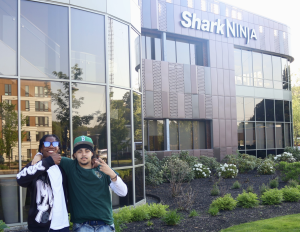 Since 2023, The Possible Zone (TPZ), an education nonprofit that prepares students for careers of the future, has partnered with SharkNinja to empower the next generation of innovators. While TPZ designs and leads afterschool programming on topics such as Autonomous Robots, Tech & UX Design for Escape Rooms, and How to Build a Care Bot, partners like SharkNinja open their doors and make career exploration even more meaningful.
“Partnerships like this help close the gap by giving young people direct access to mentorship, to industry leaders, to real world experiences, and the confidence to see themselves as future innovators and leaders,” said Franchesca Carrington, SharkNinja’s Head of Philanthropy.
The students visiting SharkNinja — most of whom attend Boston Public high schools — are part of Cooking for Humanity, a 20-session afterschool LaunchLab course run by TPZ which asks the question: How can food be both a celebration of culture and means to potentially improve health outcomes?
“At first I wanted to take this class because I saw everybody having fun, everyone was saying you should be in a class with Yari and Kahmal, [the educators],” TPZ student Sarah Andre said. By the end of the term, Sarah left the course not only more knowledgeable about personal nutrition, she was more confident in her cooking abilities.
In the Lab, students begin by sharing food stories, bringing in images of dishes that represent their culture or family, and exploring the meaning and memories these dishes carry. From there, they build culinary skills and examine how cooking methods and ingredients affect nutrition and overall health.
While on a site visit to Haley House, a local community kitchen, TPZ students learned knife safety, sanitation and setup, measuring and scaling, heat and sauté basics from the community agency’s team. Back in their class space at TPZ’s Innovation Center, students put their new knowledge to the test as they competed to create the best dish in Chopped: Ramen Edition, while exploring spices from around the world.
Throughout the Cooking for Humanity program, students conducted fieldwork, visiting families, local restaurants, and health partners to carry out interviews and collect stories about culturally rooted dishes and community health. Students then worked to modify these dishes for members of their community who may have chronic health conditions like hypertension, celiac disease, or type 2 diabetes.
Greater Boston has distinct neighborhoods, and not all of those neighborhoods have equal access to fresh, healthy food. Students noticed the disparities as they conducted research.
“For example in Dedham or something like that, they have more markets like Whole Foods, but when you see Mattapan or Hyde Park, it’s more small community-based, a lot of corner stores,” TPZ student Medjine Rene said, “I’ve seen liquor stores and it really made me think how our surroundings impact what goes into our bodies.”
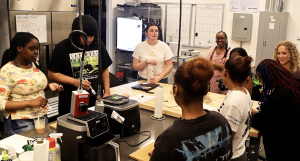 Through this course, students began building their foundation in food science, and in partnership with SharkNinja, they had the opportunity to see what that foundation could become.
“The visit at SharkNinja let me know the amount of products that people use at their house, and how useful it is to us,” Rene said. “I feel like it’s a good working environment. I do like that everything’s chill and they seem very understanding of people’s perspectives.”
Students in the four Cooking for Humanity classes offered so far this year toured SharkNinja where they learned about their patent history and heard from product designers and fabrication specialists. In the Ninja Test Kitchen, students analyzed how sugar and water ratios affect the consistency of slushies, and how different cooking oils change the flavor and smell of air fried chicken cutlets.
“I think it’s so beneficial to have a partnership with The Possible Zone. It helps me grow in my career and really think critically about what I’m doing day to day and the impact I’m making,” shared Carly Jones, food scientist at SharkNinja. “I’m happy that I’m able to help the students understand the opportunities available in the culinary world with food science. There was a lot that I didn’t know at their age about what I could do with food and the career paths available to me.”
During visits, students were able to observe professionals in SharkNinja’s test kitchen doing some of the same things they were doing in their lab: experimenting, iterating, and refining their recipes.
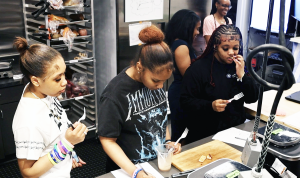 “SharkNinja helps them be expansive in that they could think about being dietitians, being food scientists, being engineers of the products they design,” TPZ educator Yari Dudley said. “Maybe I want to be a chef but I don’t want to spend long hours in the kitchen […] I can go to a space like SharkNinja and be a person that tests recipes.”
On cooking days, TPZ’s Innovation Center is filled with laughter and the enticing aroma of the students’ multicultural dishes. Using hot plates and working in teams, students measured, cooked, and assembled their meals.
The culmination of the Cooking for Humanity lab isn’t a test, it’s a published community cookbook, designed, written, photographed, and distributed by the students themselves. Each entry details a community recipe, which is analyzed for nutritional content using the USDA MyPlate framework, modified and refined to make it healthier than their inspiration dishes, and documented in a full cookbook designed using Adobe Creative Cloud and Canva. During the presentations of learning to other TPZ students, staff, and guests, students assemble their final plating, present their cookbooks, and provide feedback on each others’ dishes.
One group made a nutritious tomato pasta dish inspired by model Gigi Hadid, one group made their tofu burger even healthier by substituting a black bean patty, and another group assembled a no-bake chocolate banana pudding recipe.
“I learned to cook in a more healthy way – knowing how many calories, fat, all of that that was going into my body,” Rene said. She acknowledged the disparities between communities, “rich areas and less profited areas – the food that they’re providing, the resources that they’re provided are really different.” As they, along with their recipes go out into the world, Medjine and her lab mates carry with them the understanding that food isn’t just sustenance, it is culture, medicine, and a powerful tool for change.
“Being able to create culturally responsive meals is cool and important, and I think that drew a lot of students in who may not necessarily find themselves in certain spaces, like being able to code, or might be a little too shy to do podcasts, but they’re like ‘I could eat though,’“ Dudley said about the students who had other STEAM-focused labs to choose from. “I think it’s cool because this class helps them build upon skills that they may not have known they could transfer into other places.”
A special thank you to instructors Yari Dudley and Kahmal London for leading this course with creativity, care, and commitment; Franchesca Carrington and the team at SharkNinja, and Haley House for sharing their expertise and making this lab possible.
–Aiden Stein is a Communications Intern at The Possible Zone and a graduate of Northeastern University.