
Self-Efficacy: A Hidden Driver of Career Success
At a recent Presentations of Learning showcase at The Possible Zone (TPZ), a student shared a profound reflection on his culminating project: “I am proud of what we created because it is innovative. We developed something entirely new, and seeing it function made me realize I have the capacity to lead projects like this in the future.”
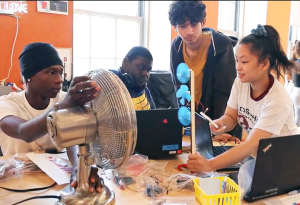 His project, developed within TPZ’s career-connected LaunchLab focused on Technology and UX Design, was an immersive escape room powered by code, sensors, circuits, and user-centered design principles. Along the way, students learned to wire breadboards, program inputs and outputs, test prototypes, and refine their ideas based on user feedback. But the biggest takeaway was not a technical skill, it was the confidence students built by turning their ideas into something functional and real over the ten-week experience.
In education and career-connected learning, discussions often emphasize preparing youth for in-demand careers or emerging sectors in the trades by focusing on technical proficiency, AI literacy, and durable skills. While these are critical for economic mobility, there is a more fundamental driver of success: a young person’s belief that they can learn, adapt, and have agency to make decisions that impact their lives.
Psychologists identify this as self-efficacy – the internal conviction that one can learn, adapt, and make impactful decisions. It serves as the essential bedrock for individual drive, flourishing, and the realization of meaningful success. At TPZ, we recognize self-efficacy as one of the most important core competencies essential for thriving in an evolving global economy.
Self-efficacy is the belief that “I can.” It’s not, “I’m talented,” or “I never fail.” Rather, it means: “I believe I can figure this out.” That distinction matters. In a world defined by uncertainty, the ability to learn new things and persist through challenges is as important as any technical skill.
Research consistently shows that self-efficacy influences how people approach difficult tasks, how long they persist when faced with obstacles, and whether they view setbacks as evidence of failure or opportunities for growth. Individuals with strong self-efficacy are more likely to take on challenges, recover from mistakes, and continue pursuing ambitious goals. At TPZ, self-efficacy is built through authentic, career-connected experiences like the Escape Room LaunchLab in which students engage in hands-on learning alongside industry professionals and educators.
When young people are trusted with meaningful work alongside adults in the field, they gain proof of their own capability. Each challenge tackled, each prototype built, or problem solved strengthens their belief that they can influence outcomes and shape their futures.
At TPZ, we describe a progression from “I could” to “I can” to “I am.”
A young person who believes they can solve problems is more likely to pursue engineering. A young person who believes they can communicate effectively is more likely to seek leadership opportunities. A young person who believes they can navigate uncertainty is more likely to pursue emerging fields that don’t come with a roadmap.
In-demand careers of the future require technical knowledge. But they also require adaptability, communication, and continuous learning, each of which is strengthened by self-efficacy. After all, people rarely pursue opportunities they don’t believe they can succeed in. As educators, we need to consider a deceptively simple question: Are we creating environments and learning experiences that help young people recognize, reflect on, and build confidence in their own capabilities?
True opportunity is seized by those who believe they can grow. Before students can define their impact, they need opportunities to experience success and see that their actions matter. Our responsibility is to facilitate the conditions where youth build this belief, enabling them to transfer their confidence and skills toward shaping a vibrant future.
Meg Riordan, Ph.D., is Chief Learning Officer at The Possible Zone.