
- Explore the evolving roles of humans and AI in teaching, learning, assessment, and feedback.
- Consider multiple perspectives on how AI can support—or unintentionally undermine—student agency and educator expertise.
- Apply practical principles for making thoughtful, human-centered decisions about AI in learning design.
Back to News & Events
August 4, 2026
Humans in the Loop: Where AI Helps—and Where It Shouldn’t SXSWEDU
Play this video to learn more about the SXSW EDU proposed panel, “Humans in the Loop: Where AI Helps—and Where It Shouldn’t”
[VOTE FOR THIS PANEL]
SXSW EDU 2027 Proposal
Session Title: Humans in the Loop: Where AI Helps—and Where It Shouldn’t
Session Format: Panel Discussion (60 minutes)
Primary Track: K-12 Innovation, Career-connected learning, Technology
 Description:
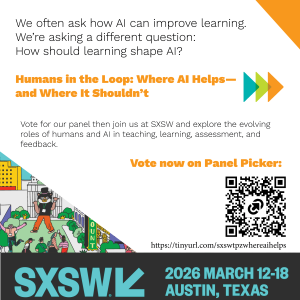
We often ask how AI can improve learning. We’re asking a different question: How should learning shape AI? Leaders from research, practice, and AI innovation explore how schools can cultivate the relationships, agency, creativity, and judgment that technology doesn’t replace. It’s not a tools’ conversation. It’s about the architecture of human-centered learning. Participants will learn how to design experiences that strengthen durable skills while ensuring technology amplifies, rather than replaces, what makes us human.
Participant takeaways:
Moderator:
Meg Riordan
Meg Riordan, Ph.D., is an education leader with 25+ years of experience designing learning ecosystems that expand access to careers and economic mobility. As Chief Learning Officer at The Possible Zone, she leads thought leadership on career-connected learning, durable skills, and scaling innovation. Previously, as Director of External Research at EL Education, she led a national study on curriculum, coaching, and student outcomes. She also served as Regional Director at NYC Outward Bound Schools. Meg co-authored Going to Scale with New School Designs and has published in the Journal of Experiential Education, Education Week, and Edutopia. Her work bridges research, practice, and industry to reimagine opportunity for young people.
Speakers:
Alison Lee
Alison Lee, Ph.D leads The Rithm Project’s youth-focused research and emerging tech foresight. A researcher and product strategist by training, she’s dedicated her career to designing for belonging, safety, and youth thriving—applying her expertise at both ed nonprofits and tech giants alike, most recently leading research on safety and integrity at Instagram, and Responsible AI at Meta.
Hilah Barbot
Hilah is the Head of Strategic Partnerships at Playlab, where she helps educators harness AI for impact in education. She previously spent four years at Amazon Future Engineer broadening computer science access globally and served as National STEM Director at the KIPP Foundation. She began her career with Teach For America at KIPP New Orleans, earning two national teaching awards. A UVA and Penn graduate, she can often be found chasing her two young kids and two crazy pups in a park in DC.
Sabrina Tirachen
Sabrina is a Lead Educator at The Possible Zone, who designs and teaches career-connected, project-based STEM and AI learning experiences for HS students. She previously led online learning and educator professional development, helping teachers redesign experiences to engage remote learners. She develops curriculum that integrates emerging technologies with real problem solving, guiding students as they build, test, reflect, and develop durable skills. Her work demonstrates how AI can support creativity, collaboration, and student agency while keeping students at the center of learning.
VOTE FOR THIS PANEL
Do you have a question you want the panelists to address? Please share it in the Comment section below.