
Entrepreneurship Education Builds Careers, Not Just Companies
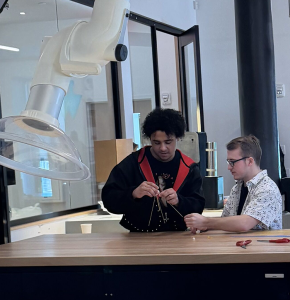 What if the next great consumer product came from a young person with no prior business experience — and building it was also their first real job? That’s the bet behind Ventures Launch, The Possible Zone’s (TPZ) product incubator. Through our Launch program, young adults from Boston, several of them TPZ alumni, join as paid Founding Associates. Over six months, each of the Founding Associates research market trends, design new consumer products, and work to bring it to market alongside our product team, industry experts, and manufacturing partners.
The model is built to do two things at once. Products that succeed generate earned revenue that flows back to support TPZ’s career-connected educational programs; our first successful product, Bible Clock, sold nearly 10,000 units in its first year. Regardless of whether their product launches, every Founding Associate leaves with real experience in product management, digital marketing, and e-commerce operations.
That second part is worth focusing on during Entrepreneurship Month. Young people are interested in entrepreneurship — about one-third of Gen Z say they’d like to start their own business someday. But most can’t afford to, at least not right away. So what is entrepreneurship education actually for? Our answer: entrepreneurial spirit is a mindset first and a career path second.
The Ventures’ Team has honed in on Launch’s key learning goals and refined the program across its first three cohorts. Below are reasons we think hands-on, entrepreneurship programs like Launch are meaningful models for educating young adults anywhere.
1. Entrepreneurial mindset is a skill set employers are already hiring for.
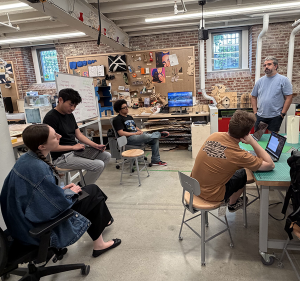 The World Economic Forum’s Future of Jobs Report 2025 surveyed more than 1,000 employers. They ranked analytical thinking as the top core skill desired by employers, followed by resilience, flexibility, and agility. Artificial Intelligence (AI) and big data topped the list of fastest-growing skills, with creative thinking and curiosity close behind. These read like they’ve come out of a job description for a startup founder.
The good news is that this collection of skills and way of thinking can be taught. A study of high school students found that entrepreneurship education led to measurable gains in opportunity recognition, problem-solving, and collaboration — and those gains tracked with students’ confidence in their future careers.
We see the same thing in Launch. In this six-month intensive sprint, for example, understanding and using technology effectively for optimizing discovery to prototyping is essential. One of our current Founding Associates described learning a new AI rendering tool as “teaching myself” initially, but then “so worth it” after putting it to practical use. Another reflected that the AI training “will change my career.”
2. Real stakes make the learning stick.
Launch isn’t a simulation. Founding Associates talk to real customers, run real ads, work directly with manufacturers, and make decisions with real money behind them. Through our stage-gate process, every product has to earn its next round of investment against clear benchmarks for market demand, financial viability, and time to market. And when the data says stop, we stop. That’s the part of entrepreneurial spirit that’s hardest to teach in a classroom: knowing when to push forward and when to walk away. Every challenge is an opportunity to learn and grow. One Founding Associate admitted they “didn’t think it was real” going in. Another was surprised by how much they could do on their own so quickly — things they’d assumed you had to “pay someone thousands of dollars to do.”
3. Paid, portfolio-building work opens doors.
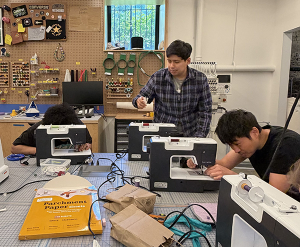 Not all work experience counts equally. NACE research found that students in paid internships received more job offers and higher starting salaries than those in unpaid ones — a median of $67,500 versus $45,000. Those paid roles also aren’t evenly distributed: white and male students are overrepresented among paid interns. That’s why TPZ Ventures Launch program is a paid role, and why we’re adding a curated work portfolio and formal project management certifications. Early career professionals are building essential skills and networks here. Founding Associates in the diverse cohorts report they’d recommend the program to a friend. “Getting paid to learn is never something you should turn down,” one recent Founding Associate told us. Another put it simply: “Where else are we getting paid to develop our portfolio?”
This is where the model comes full circle. When the cohort cycle ends, Founding Associates whose products advance can stay on to scale them, with a salary and a share of the upside. Others move into product management, digital marketing, and e-commerce roles, with support from our corporate partners. Of the 15 students who have participated in the three TPZ Ventures cohorts – including six who are alumni of TPZ’s high school program – three have gone on to be educators in TPZ’s career-connected educational program for high schoolers, bringing with them an entrepreneurial mindset and spirit. Six are supporting products that came out of the cohorts, even if they’re not the product they initially founded. The others have gone on to roles outside of TPZ in education, design, or to start their own small business.
What we’re really building
TPZ’s Theory of Change describes a progression from “I could” to “I can” to “I am.” Entrepreneurship is one of the fastest ways we know to move someone along it. Building something real, putting it in front of customers and living with the results changes how young people see themselves.
We’re not trying to turn every young person into a founder. We’re giving them a real shot at finding out what they’re capable of — with skills that go with them wherever they land next. For Boston’s young people, that’s what economic mobility looks like in practice.
– April Warren is s Vice President, TPZ Ventures Strategy & Operations