
Hands-on Making and Creating Helps Students Discover Who They Are
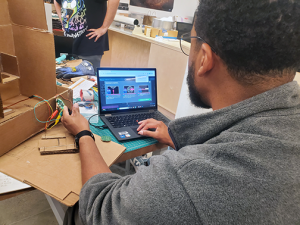
Lead Educator Chris Essex works on a coding project during the Cardboard Architects LaunchLab.
As a student, I often had a hard time finding an appropriate vehicle for demonstrating my learning. I couldn’t always convey my understanding of the content in ways that were valued in school, like on tests or written assessments. This challenge would plague me throughout my scholastic career. But then, when I was a high school senior, Ms. Repke, one of my teachers, allowed me to make videos as a form of reflection instead of writing an essay. That experience enabled me to tap into my creativity and show my learning in a way that felt more authentic to who I was. Fast forward over a decade later, and in my own process as an educator, I often look for ways for students to make personal connections to how they demonstrate their understanding of learning experiences and content.
For me, the most powerful way to build connection is through the act of creation; and at TPZ we “make.” We play, we learn, we make, we learn, we play, and we make some more. Here we believe that learning happens in motion, a practice in constructionism, coined by Seymour Papert, which argues that cognitive learning happens best when students create a tangible and external artifact for an authentic purpose or audience. In our team meetings we discuss handstorming – which contrary to brainstorming, means generating ideas by doing instead of offering solely thoughts. We carry that energy into our classes and offer students the space to participate in this practice as well. When students are given the freedom to build in this way, the entire nature of how they internalize information changes. Students, for example, can do anything – from learning about cybersecurity by designing escape room experiences or constructing cardboard arcade games to understand prototyping and design; they can even sew to explore issues in textile waste. Each one of our LaunchLabs is a career-connected, project-based learning experience where students create to answer authentic questions in the world.
Why is this important? What is it about making that I believe in so much?
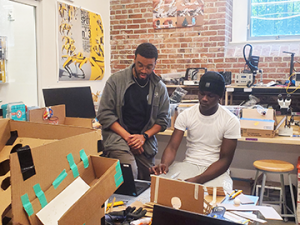
Lead Educator Chris Essex works with a student on a project during the Cardboard Architects LaunchLab in the TPZ Fab Lab.
To me, the answer is simple: making allows for a sense of ownership and agency over one’s learning. It allows space for students to try their ideas in context and to grow from the experience of action, reflection, and reaction. Students in our courses learn new skills and immediately apply those skills in a safe and exploratory context. What they gain from such an experience is not only an understanding of these skills but also how they can apply them in a way they choose for themselves. This philosophy aligns closely with the core tenets of situated learning theory, which suggests that abstract concepts are best mastered when they are embedded within a physical, active context rather than taught in isolation. This theoretical framework isn’t just an academic ideal; it is a living reality I have experienced and practiced firsthand throughout my career.
My goal as an educator has always been to support students in ways that I felt I (and others) needed. I’m proud to say that I am able to do that work at TPZ and have seen my students reap the benefits of it. Teaching in makerspaces for over a decade now, one thing that has been consistent across all those spaces is the enjoyment students get from creating something themselves. In the Makerspaces I’ve worked in, we rarely had artifacts to showcase because students always wanted to take their work home with them. This shows a great level of personal connection that students feel over what they’ve created and the profound sense of ownership they develop over their own capabilities. Witnessing them unlock that agency is precisely what keeps me rooted in this mission.
– Chris Essex is a Lead Educator at The Possible Zone