
Internships That Matter: 5 Practices That Turn Experience into Opportunity
High school internships are often positioned as one of the most powerful bridges between learning and work. They frequently emerge in school redesign efforts as a promising opportunity to expose young people to careers and durable skill building. And yet, for most students, they remain out of reach. Today, while nearly 80% of high school students say they want an internship, only about 5% actually have one. That gap is not just a missed opportunity, it’s a system failure.
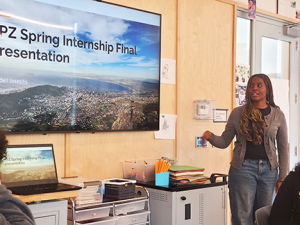 It matters because the research is clear: internships are an effective way for young people to build the skills, networks, and direction that shape their futures. Students who engage in internships develop critical competencies like communication, teamwork, and problem-solving, while gaining exposure to real-world expectations and professional environments. More broadly, career connected learning experiences are strongly linked to career clarity, confidence, and access to future opportunities, including employment and postsecondary pathways.
The impact goes beyond skills. Internships expand social capital, which is often a hidden driver of economic mobility. However, access to these experiences is shaped by geography, industry and professional networks, and awareness, rather than student potential.
At The Possible Zone, we think about internships as a core part of a learning model designed to build agency and durable skills, expand networks, and create real pathways to in-demand careers so that students are poised to shape their futures.
Here are five practices, grounded in research and informed by The Possible Zone, Big Picture Learning and P-TECH, that prioritize internships that matter.
1. Anchor internships in interests
Strong internship models begin with student interests, identity, and goals. Big Picture Learning’s long-standing approach to “learning through interests / internships” demonstrates that when experiences are aligned to what students care about, engagement and persistence increase. At TPZ, this begins well before an internship. In our LaunchLabs, students explore high-demand industries through experiential projects connected to areas like healthcare or AI. When they engage in career-connected opportunities, they’re not just guessing; they’re testing and refining emerging interests.
2. Make skills visible and intentional
Internships should be designed to build durable skills: communication, problem-solving, adaptability, and collaboration. Research consistently shows that high-quality internships strengthen these competencies when they are explicitly named, practiced, and reflected on. Through TPZ’s Pathways programming, students don’t just “do” internships; they track their growth by reflecting on authentic challenges, connecting experiences to competencies like creativity and STEAM agency, and sharing artifacts to demonstrate learning. If we design for skill-building, we are more likely to ensure it happens.
3. Build relationships
A powerful outcome of an internship isn’t only what students do, it’s who they come to know. Mentorship and networks are the hidden architecture of opportunity. Research shows that many students secure jobs through connections formed during internships, underscoring the role of relationships in shaping future pathways.
In the P-TECH model, internships are a bridge between school and career, giving students structured opportunities to work with industry partners like IBM and build real-world experience before graduating. They also promote mentorship, enhancing powerful relational skills that complement STEAM expertise. At TPZ, like P-TECH, internships are intentionally designed as relationship-rich experiences: students engage alongside industry professionals and their experiences move beyond exposure to workforce experiences to contributions to the professional community.
4. Integrate career-connected learning
Internships are most effective as part of a coherent system, not a standalone experience. The CAPS Network and other career-connected models successfully embed real-world learning into curriculum, projects, and assessment. At TPZ, this means connecting LaunchLabs, Career & Technical Education (CTE) pathways, and work-based experiences into a progression. For instance, a student interested in healthcare might engage in a LaunchLab after school and design a health-related project with an industry professional; they might then build technical knowledge and gain industry exposure in a clinical setting during a schoolday CTE course. Next, the student applies learning through a sustained internship at the local hospital. This coherence transforms experiences into learning and activates pathways to economic mobility.
5.  Design for pathways
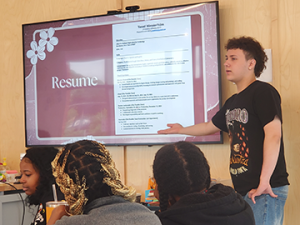
A strong internship is not the end goal. It’s an on-ramp. Research shows that internships increase career clarity and future opportunity when they are connected to next steps: additional experiences, credentials and certifications, or employment. Exposure matters. But access to opportunity and advancement matters more. At TPZ, we design for a longer arc, building skills and positioning young people for career opportunities in in-demand industries like healthcare and advanced manufacturing. Through partnerships with organizations and colleges like National Grid, Converse, Tremco Rising Stars, Shark Ninja, Wentworth Institute of Technology, and Franklin Cummings Tech, students can envision career runways that include dual enrollment, job shadowing, internships, and employment. It’s not a single experience; it’s about momentum and reflection on who these young people are and where they see themselves in the present and future.
Internships can be transformational when they are designed with intention. They aren’t just about preparing students for discrete tasks. They are about increasing durable skillsets, expanding who students know and what they believe is possible, and magnifying where they can go next. They are promising opportunities that more high school students should be able to realize.
Meg Riordan, Ph.D., is Chief Learning Officer at The Possible Zone.