
Why STEAM Agency Matters: It’s a Rapidly Changing World
There’s no question that young people must be ready to navigate the digital age we live in and to access promising pathways to economic mobility. Therefore, as educators, we must emphasize that the work is not only about teaching tech and tools, but building agency: the ability to question, create, collaborate, and adapt alongside technology.
At The Possible Zone, we see STEAM agency as a progression – what our Theory of Change describes as moving from “I could” to “I can” to “I am.” It begins with exposure and curiosity, grows into confidence through practice, and ultimately becomes identity: I am someone who can use tools and technology to design, build, and solve real problems.
We define STE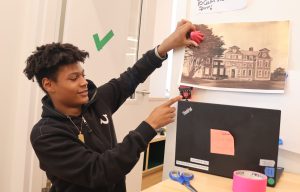 AM agency – one of the 14 competencies in our career-connected and project-based program – as feeling capable to effectively and responsibly use tools and technology across science, technology, engineering, arts, and mathematics. But more importantly, it’s about how students see themselves in relation to that work. It’s the shift from following scaffolded directions to creating, iterating, and improving on ideas that matter, and from completing small tasks to recognizing opportunities and shaping their outcomes.
That shift is critical. We are living in a time when artificial intelligence (AI) and emerging technologies are not just changing jobs; they are reshaping what it means to be prepared for post-high school education and careers. Research suggests that AI-integrated STEAM learning environments can actually strengthen critical thinking, creativity, and problem-solving, particularly when students engage in interdisciplinary, applied work. At the same time, employers are signaling that what matters most is not only technical expertise, but the ability to collaborate, adapt, and make decisions in complex environments. The implication is clear: success in a digital, AI-enabled economy will depend not just on what students know, but on how they apply knowledge, navigate complexity, and continue learning over time. STEAM agency is how we build that capacity.
At TPZ this shows up in how high school students engage with tools and technologies in our Deep Dives and LaunchLabs. In an Escape Room Lab, where students work in teams to tackle authentic cybersecurity challenges with the aim of protecting information, young people learn to code with Micro:Bit, intercept and encrypt data, and design puzzles that reveal how systems can be hacked and defended. By its very nature, the work requires testing and revising, learning from failures, and collaborating effectively with peers. Evan Danenberg, a TPZ Educator / Advisor, observed: “In our Escape Room Lab, one student initially said, ‘I’m not creative. I’m not great at building.’ But her teammates hyped her up and because of that sense of belonging and teamwork, she started to see herself differently.”
Over time, something deeper happens as students develop STEAM agency. They move from “Could I do this?” to “How can I make this better?” to “What else am I excited to build?” That progression is not just about skill, it’s about identity. TPZ Computer Science & Multi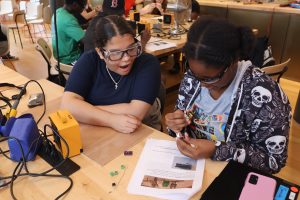 media Education Senior Technician Miles Baird explains, “We try to create an environment where students are inspired. In a recent Autonomous Robots Deep Dive, our students wrote short reflections from the perspectives of their robot, like, ‘Today I was born,’ and ‘My creator is weird.’ Students wrote about the failures and successes of their robots and could see their own identity as STEAM makers with a new lens.”
Research underscores this connection: when students see themselves actively engaged in STEAM experiences and feel a sense of belonging, they are far more likely to persist in those fields. This is particularly important because many students, especially those historically underrepresented in STEAM, do not initially see these pathways as accessible or relevant. Creating environments and opportunities for students to see themselves in STEAM is not a “nice to have;” it is central to expanding participation and positioning young people to access pathways to economic mobility.
This is where STEAM agency intersects with career-connected learning.
When students engage in authentic, hands-on work that mirrors real industries – whether healthcare, advanced manufacturing, or robotics – they develop not only technical skills, but confidence, networks, and a bridge to professional communities. They see how their work connects to real-world challenges. They begin to imagine themselves in future roles. And they build the durable skills that research shows are best developed through hands-on experience.
At its core, STEAM agency prepares young people for a world where change is constant. It helps them become more than consumers or users of technology, but critical thinkers and creators who can work with it. Research reinforces that students develop these capabilities most effectively in environments that are hands-on, collaborative, and connected to real-world problems
At TPZ, we see this every day. A student who once hesitated to pick up a tool now feels inspired to create. A student who struggled to explain their thinking presents a complex design to an audience. A group that was unsure at the beginning, ends up building something they didn’t think was possible.
That is STEAM agency.
And in a world shaped by emerging technologies and AI, it may be one of the most important outcomes we can design for – not because of the tools students use, but because of who they become in the process.
–Meg Riordan, Ph.D., is Chief Learning Officer at The Possible Zone.